Coming soon

Never waste
a clear night.

Alan Astro finds your target, focuses, guides and works through your plan from dusk to dawn, so you can go to bed. Check in from a laptop, tablet or phone. If anything goes wrong, it tells you what happened and why.

Windows Linux Android iPhone & iPad Any browser

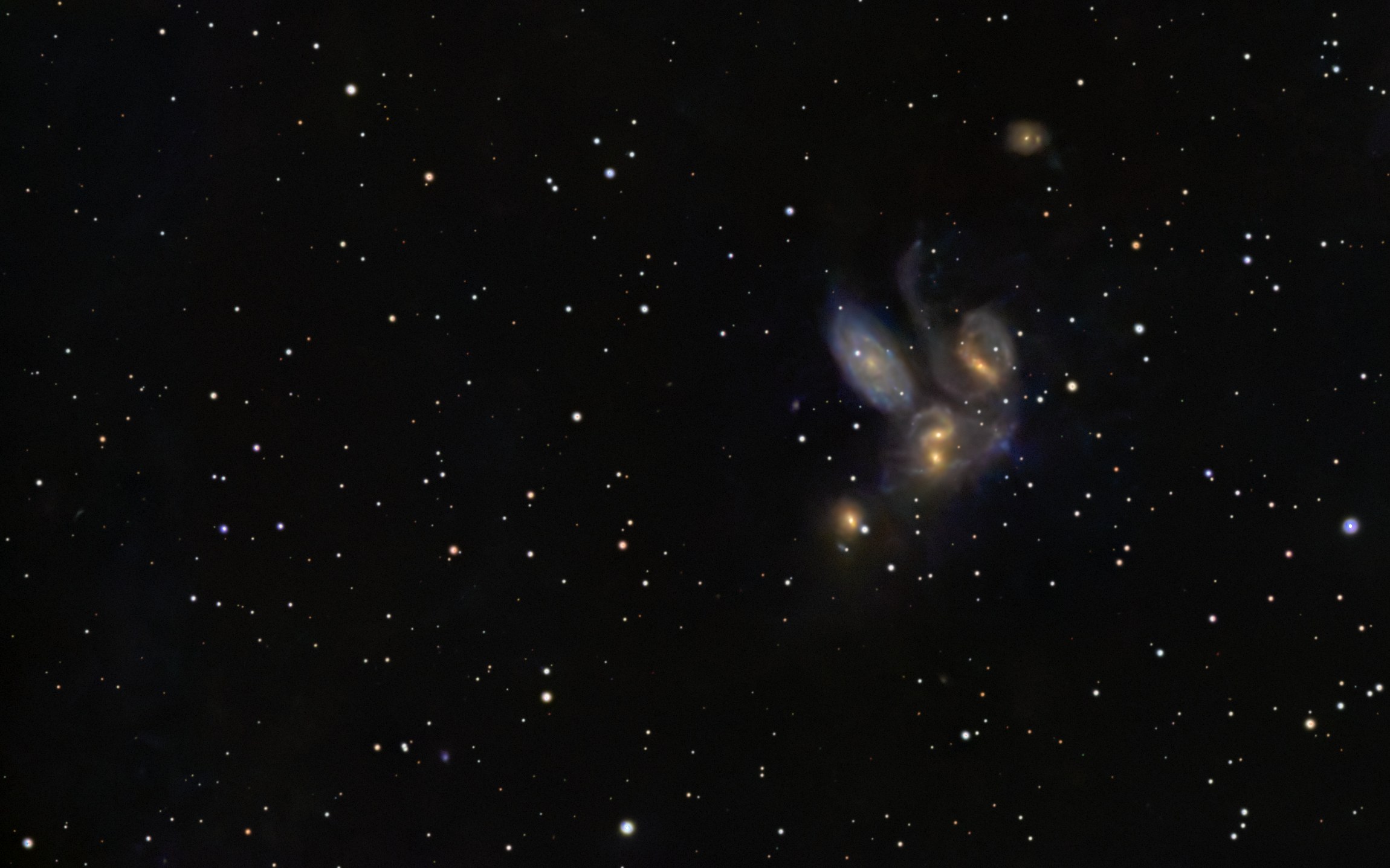
Behind this text: Stephan's Quintet, shot with Alan Astro from a Bortle 8 backyard. 2,800 mm, 38 × 3 min, guiding 0.7″.

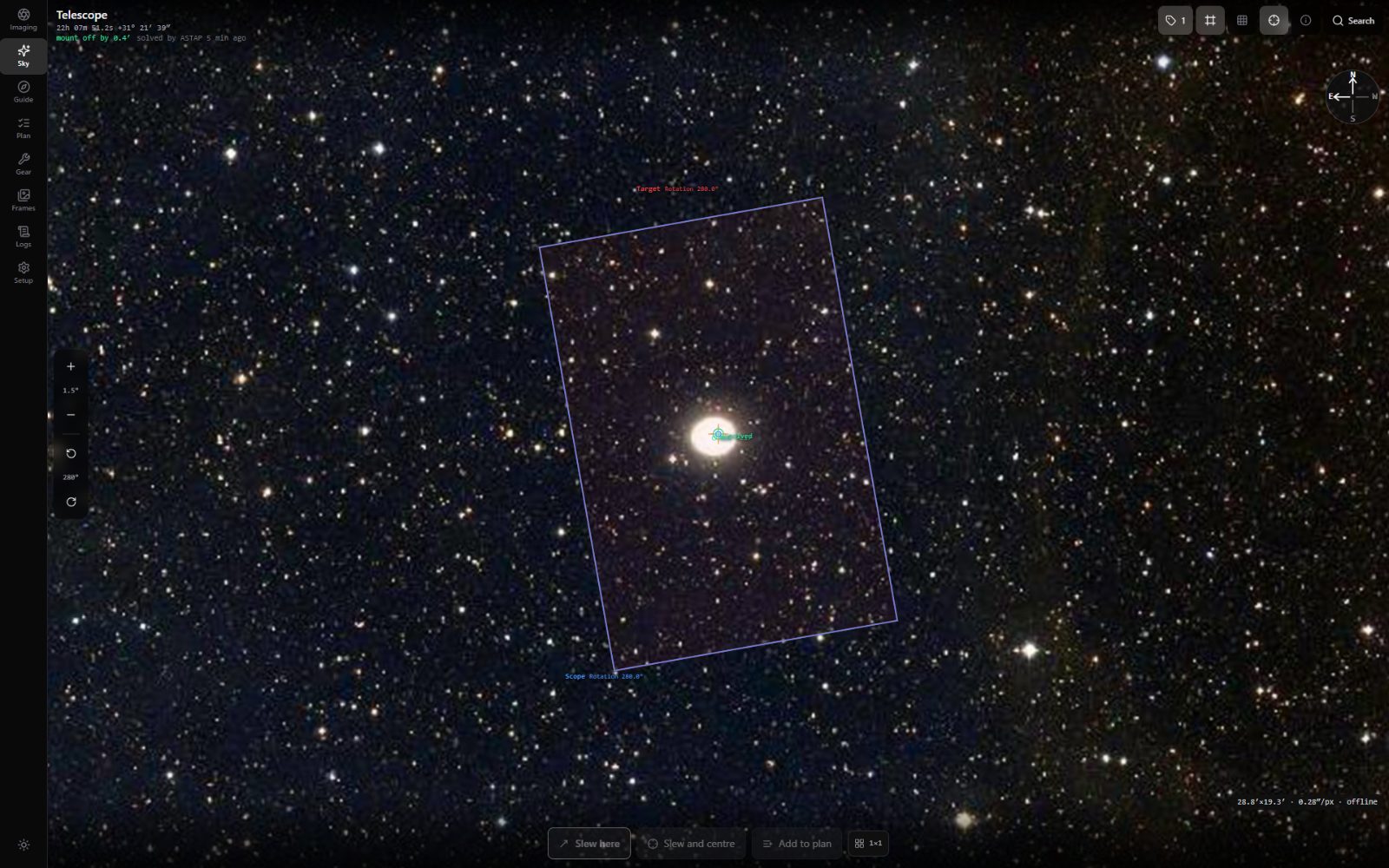
The Sky screen at the telescope on 26 October: the camera's field of view at 2,800 mm, after a plate solve
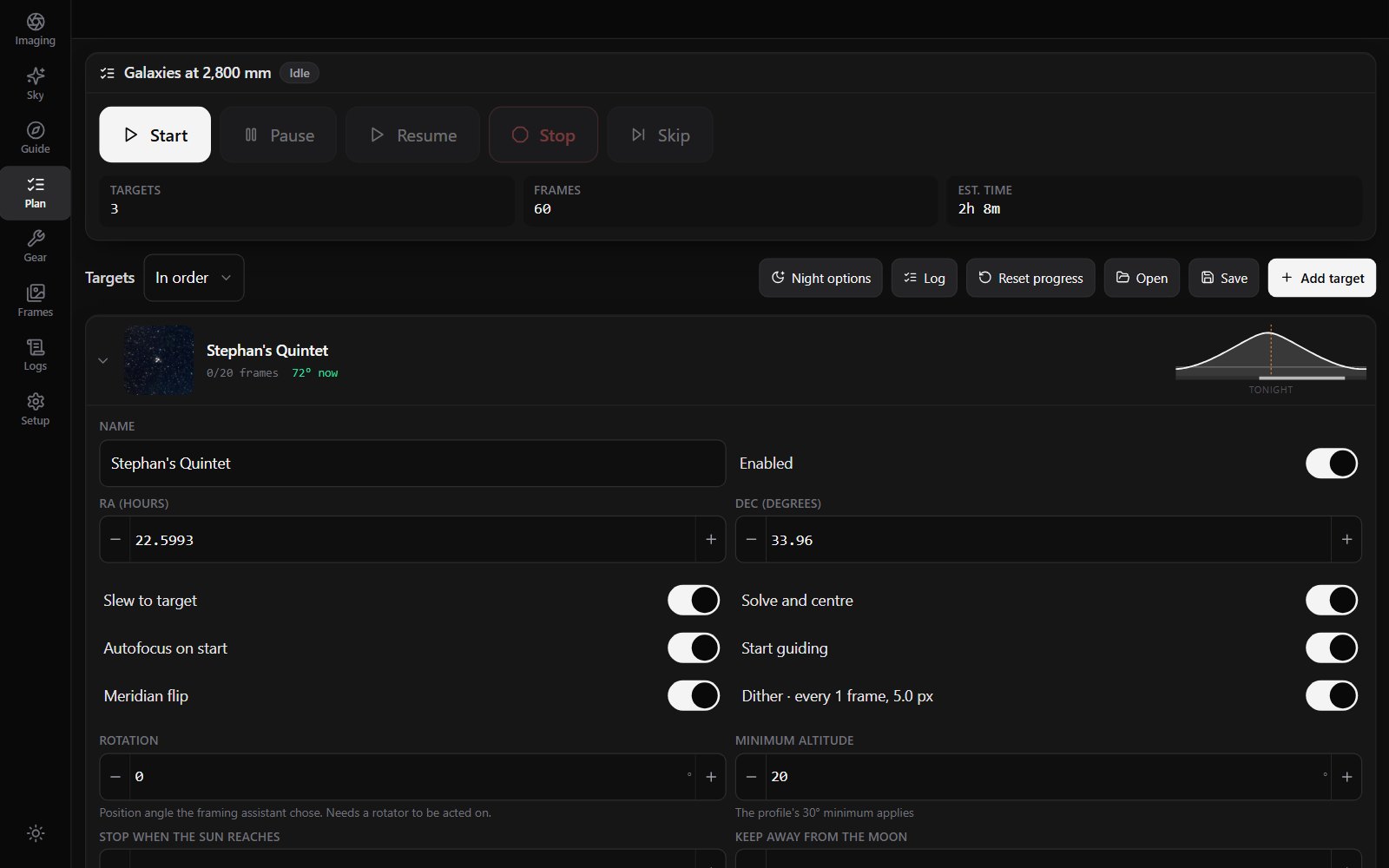
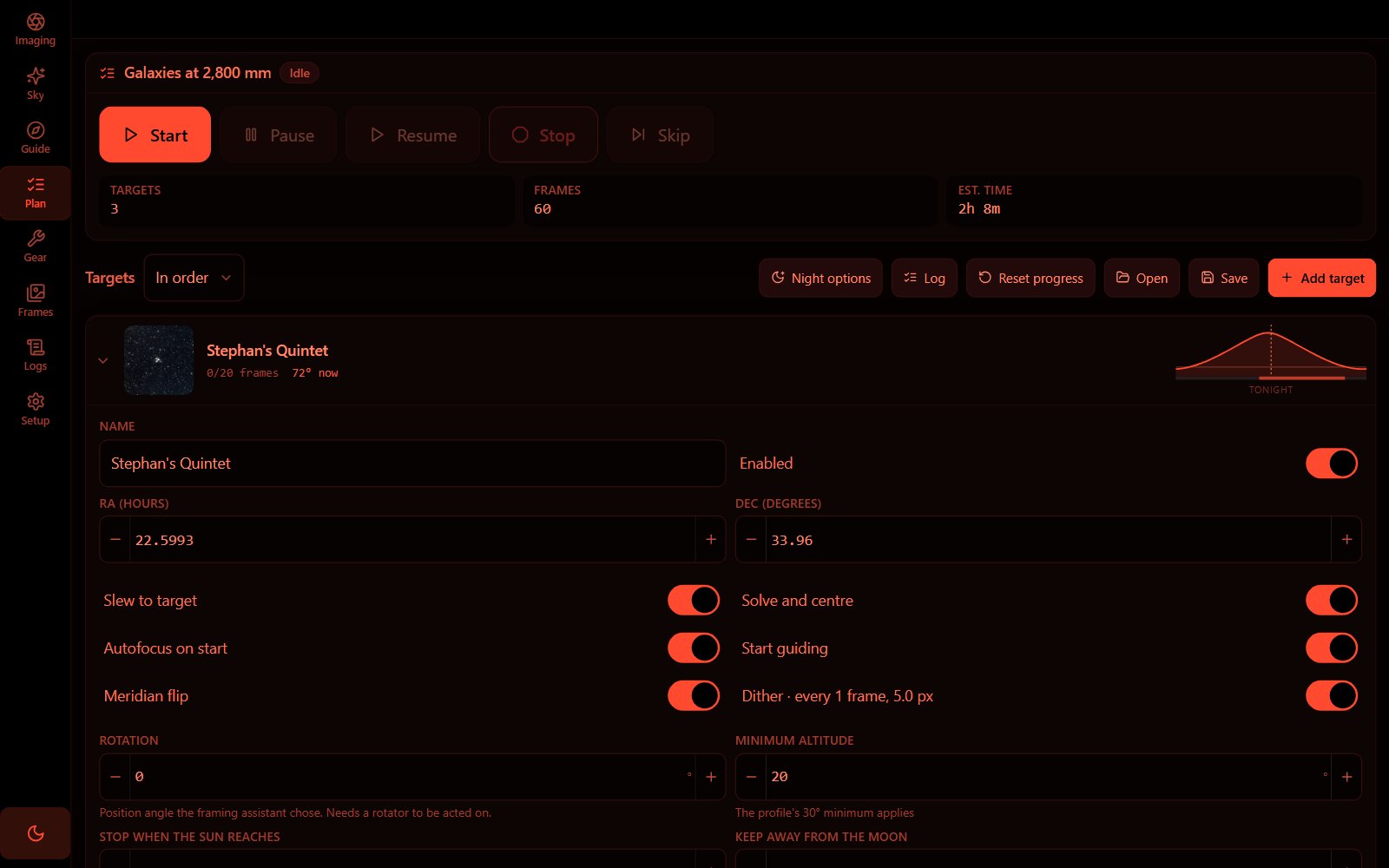
The Plan screen on a tablet
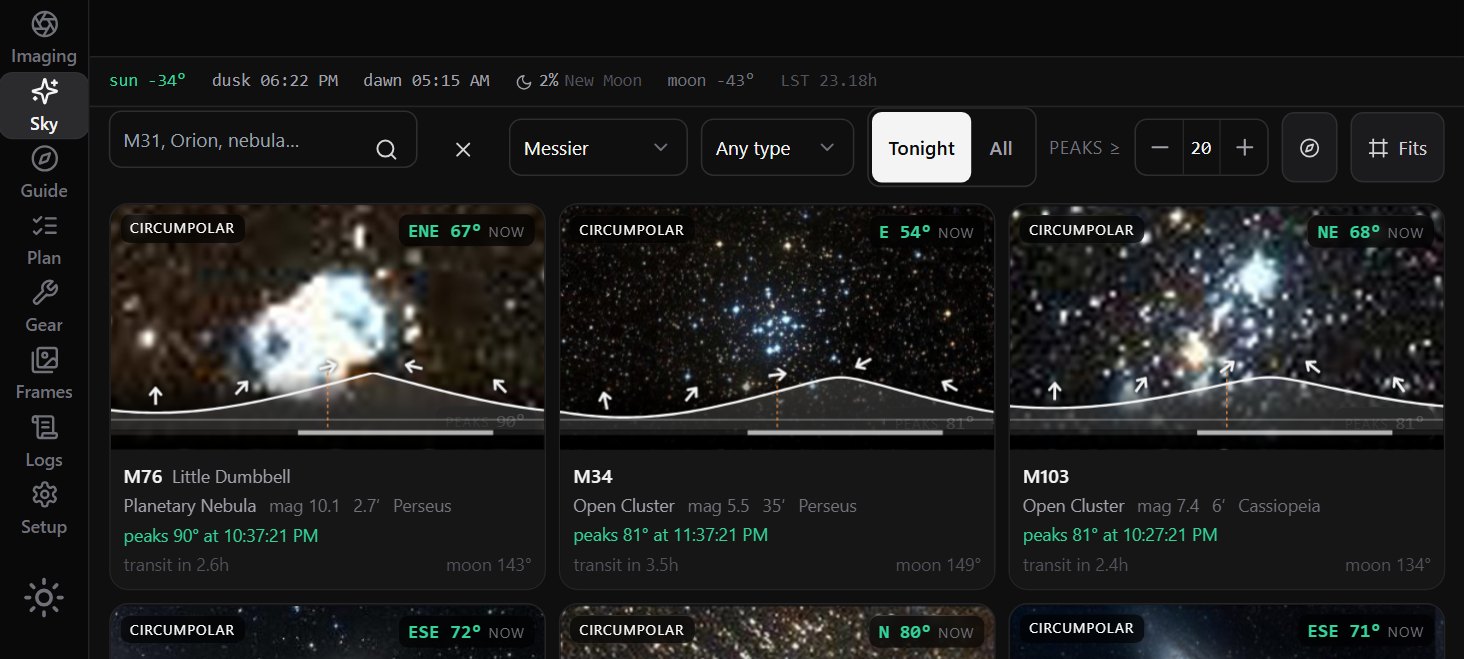
The sky atlas on a phone, held sideways
ASCOMAlpacaDSLR camerasOffline plate solvingPHD2Multi-star guidingLive stackingMeridian flipMosaic plannerFlat wizardWeather limitsYour own horizonDiscord · Slack · ntfyBacklash measurementNight mode
0.7″ RMSguiding error on real stars, and under 1″ night after night
2,800mmfocal length guided at f/10, through the main scope
18,900+objects in the sky atlas, sorted by what's up tonight
0.997R²how well the best focus curve fitted, on a real night

Guiding

Round stars, even at 2,800 mm.

At 2,800 mm, one arcsecond of error covers several pixels. A guider that only thinks in pixels needs new settings for every scope. Alan Astro's guider checks its limits in arcseconds of sky, so a setting that suits a 250 mm refractor can't end up too small on a 2,800 mm SCT.

  • Limits that know your scope

    The minimum move, the settle limit and the search area each have a floor in arcseconds, worked out for your camera and focal length, so none of them can be set too small.

  • Knows your guide setup

    A guide scope, an off-axis guider or a camera's built-in guide sensor, with binning counted in. It won't start guiding until it knows the pixel scale.

  • Several stars at once

    It follows up to five stars and uses the middle value of their movement, so one star in bad seeing can't pull the mount off.

  • Picks clean stars

    It chooses stars that stand out clearly from the background, not just the brightest, and can skip the stretched stars at the edge of an off-axis guider. On one field, that alone took guiding from 3.38″ to 1.29″ RMS.

  • A guiding assistant

    It watches the mount drift with no corrections, tells seeing apart from real drift, and suggests a minimum move.

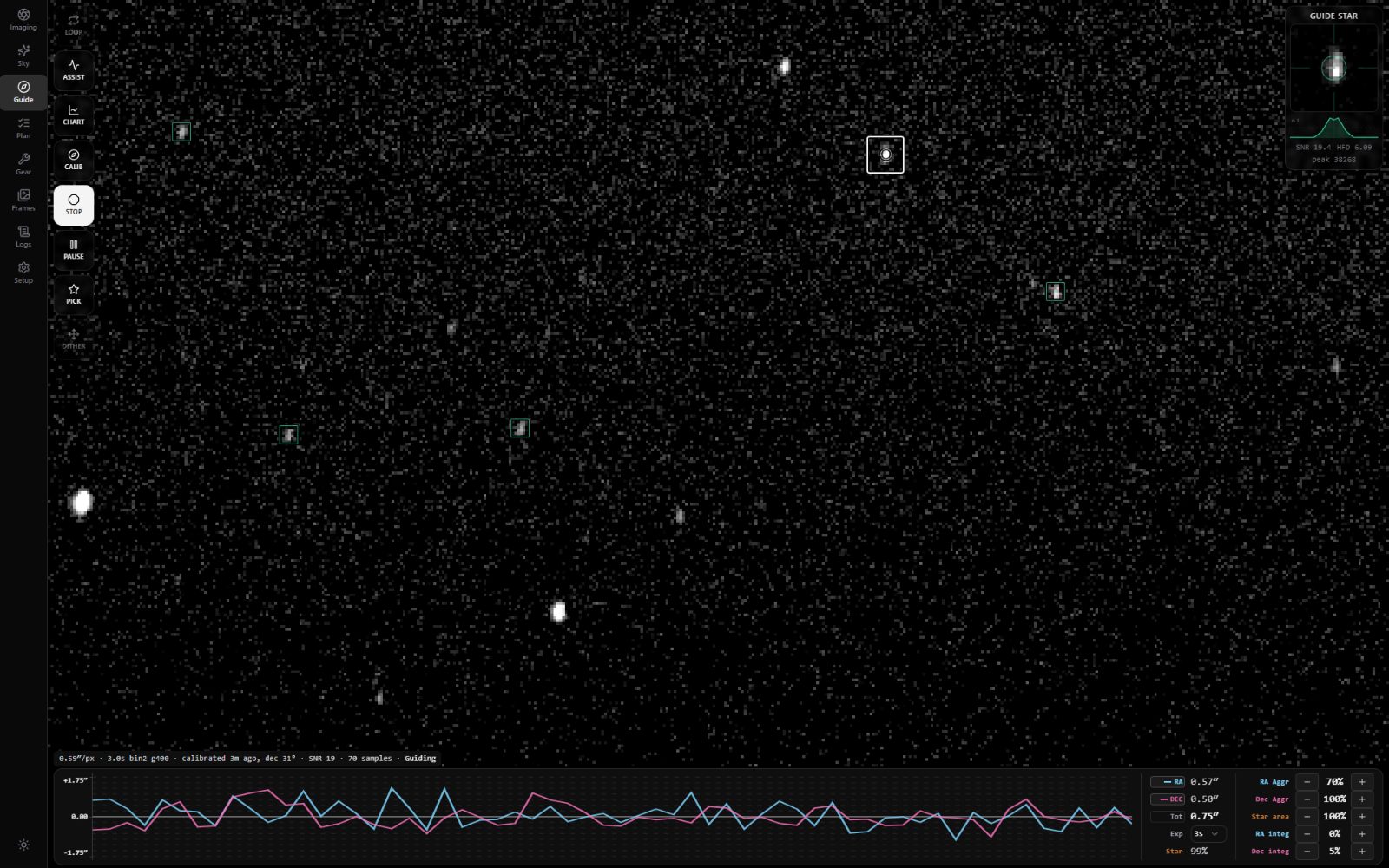
Guiding on real stars on 26 October: five guide stars boxed, and the error at 0.57″ in RA, 0.50″ in DEC, 0.75″ in total
0.7″RMS guiding,
measured on real stars
< 1″RMS,
night after night
240 mm
0.31 px
700 mm
0.90 px
1,400 mm
1.8 px
2,800 mm
3.6 px

How far one arcsecond of error moves a star on a camera with 3.76 µm pixels. At 2,800 mm it moves almost twelve times as far as at 240 mm, so a limit set in pixels would be wrong by the same amount. That's why the guider checks its limits in arcseconds.

Start the plan and go to bed. Check your frames in the morning.

Any screen

One server at the telescope. Control it from any device.

The server runs on the computer at your mount. Open it from any laptop, tablet or phone on the same network. Several screens can follow the same session, and closing one stops nothing.

Windows serverInstaller · runs as a Windows service · ASCOM, Alpaca, DSLRs
Linux serverINDI and Alpaca · the same guiding, focus and plans · coming later
No cloudNo account, no sign-in, no internet · in a field it can make its own Wi-Fi
port 5544
Any browserWindows, macOS, Linux, ChromeOS · made for touch
AndroidA native app for phones and tablets
iPhone & iPadA native app for iPhone and iPad

Tour

Find it, frame it, plan it, guide it.

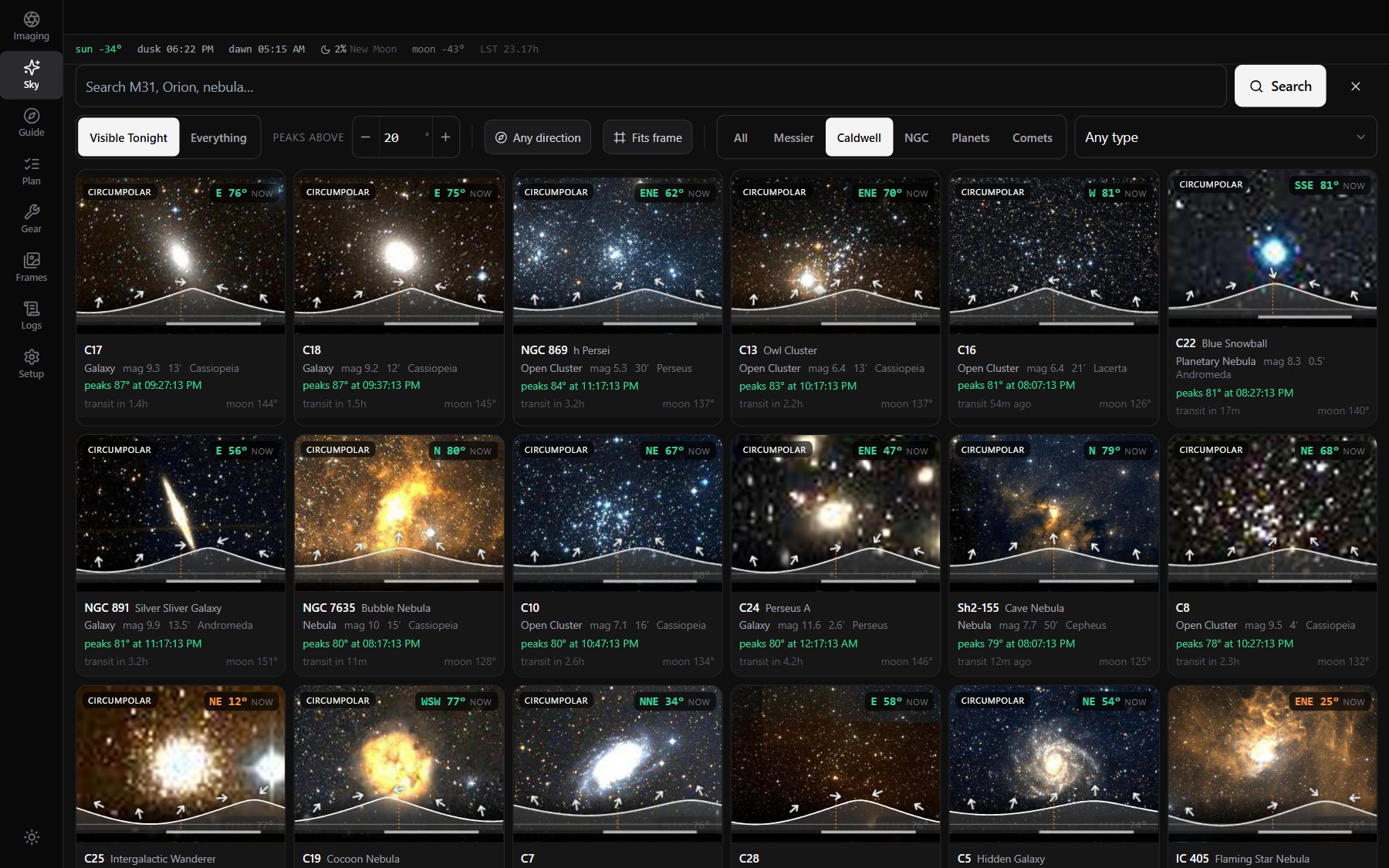
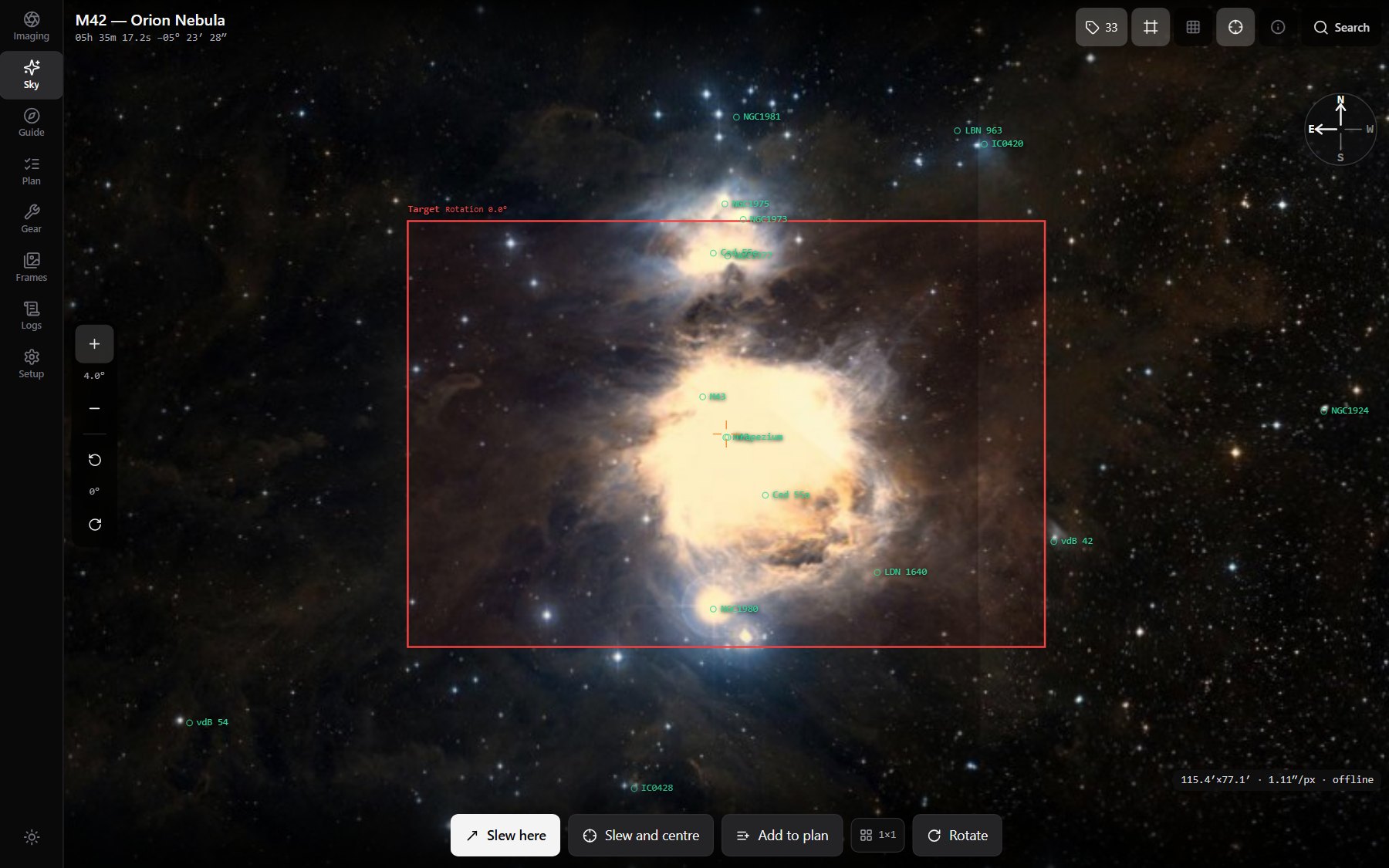
The sky atlas: targets that rise tonight, each with its altitude curve Framing M42, the Orion Nebula: the camera's field of view on the sky, with nearby objects labelled The Plan screen with three targets, Stephan's Quintet first Guiding on real stars on 26 October, at 0.75″ total

Dusk to dawn

Plan it in the evening. Wake up to data.

A plan runs the whole night, from cooling the camera at dusk to parking the mount at dawn. If the weather turns bad, it pauses and carries on when the sky clears.

Wait for darkUntil the sun is 12° below the horizon
Cool the cameraSlowly, not all at once
Slew, solve, centreUntil the target is where you framed it
AutofocusAnd reports how good the fit was
Guide and ditherWaits for guiding to settle before each frame
Meridian flipStops guiding, flips, starts again
RefocusAfter a set time, a temperature change or softer stars
Home and warm upThen an alert to your phone, if you've set one up

Also included

Everything else a night needs.

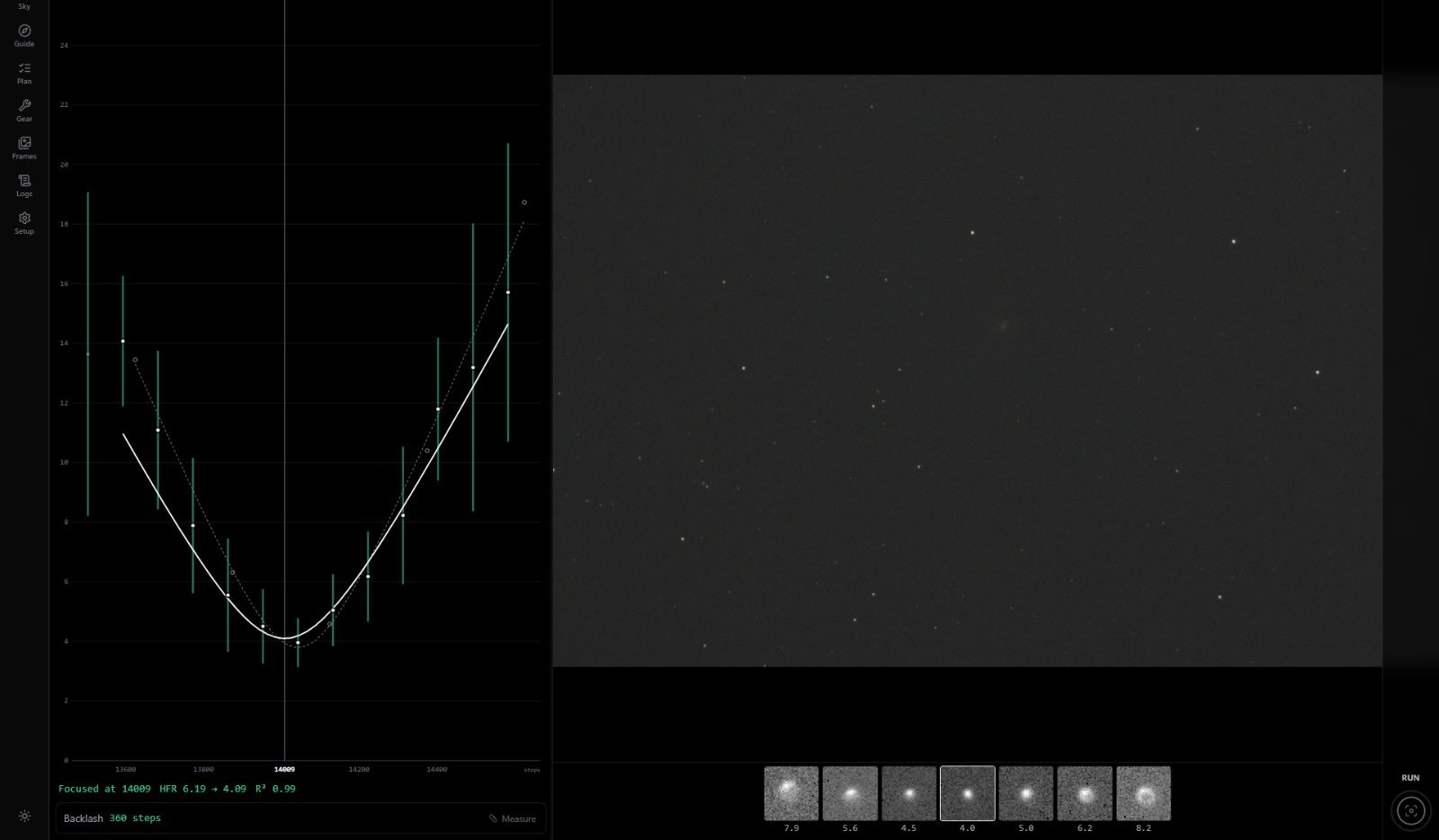
A real autofocus run on 26 October: the curve fitted through the star sizes, HFR 6.19 to 4.09, R² 0.99

Autofocus that shows its work

It steps the focuser through focus, fits a curve through the star sizes and tells you how well the curve fits. You don't have to measure backlash first: every move finishes from the same side, so slack in the gears can't move the result. It applies the focus offset you set for each filter, and if a run fails, it says so.
0.12′

Plate solving that catches mistakes

It solves on your own computer, with no internet. On a real night it centred a target to 0.12 arcminutes in two tries. It also reports the focal length it measured, so you'll notice if you forgot the reducer.

  • Works offline
  • Centres as close as you ask
  • Names what's in the frame
  • Measured vs. expected focal length

Polar alignment

Three measurements, then it shows which way to turn the altitude and azimuth knobs, and how far.

Live stacking

Frames are lined up on their stars and stacked as they arrive, with your darks and flats applied. Bad frames are left out, and it tells you why. It can stack a running plan as it goes.

Star analysis

Star size (HFR), star count and roundness for every frame, plus a tilt map that shows which way stars stretch across the field.

Sky atlas cards with altitude curves for Caldwell objects

A sky atlas for tonight

Over 18,900 objects: OpenNGC, the Messier, Caldwell and Abell lists, nebula and cluster catalogues such as Sharpless and Barnard, and the planets and comets. It shows what gets high enough in darkness tonight, in the directions you can see. Each target has its altitude curve with your horizon drawn on it, when it's highest and how far it is from the Moon. There's a mosaic planner too.

Safe while you sleep

Six weather limits (wind, gusts, rain, cloud, humidity and dew) pause the night and pick it up again when conditions clear, instead of ending it. A safety monitor that stops answering counts as unsafe. Your own horizon applies to every slew.

  • Discord
  • Slack
  • ntfy
  • Home Assistant

One webhook sends you alerts: errors, a plan starting or finishing, and a device dropping out or coming back.

Night mode

Easy on your night vision.

Drag the handle to compare. Text, charts and buttons all turn deep red, so your eyes stay used to the dark.

The Plan screen in the day colours The Plan screen in night mode DayNight
Red, not whiteEven the brightest text is a soft red, and a dimmer can take the screen down by up to 70%. Red light disturbs night vision least.
Turns itself onUnless you've picked a theme yourself, it switches on after dusk and remembers, so the app never opens on a bright screen in the dark.
Try it here

Hardware

Works with the gear you already have.

Download

Coming soon.

Alan Astro isn't available to download yet. Want to hear when it is? Email alan.astro.space@gmail.com and we'll let you know.

Windows

Installer · 64-bit

Installs a Windows service that starts with the computer and serves the app on port 5544. Open the address it shows from any browser on your network.

  • ASCOM · Alpaca · DSLRs
  • Runs in the background as a service
  • Installs over an older version
  • A simulator for every device, to try it indoors
Coming soon

Android

Native app · phones and tablets

Coming soon toGoogle Play

iPhone & iPad

Native app

Coming soon to theApp Store

Linux server

INDI and Alpaca

Linux buildComing soon

You won't need an app: any browser on the same network will work.